of body weight, yet about 20% of resting energy, belongs to the brain[1]
of nightly sleep recommended for adults by sleep specialists[2]
of learning demanding skills was followed by memory gains in older adults[3]
These studies were carried out independently and did not evaluate Mind Armor: The Memory Defense System; they support the general information on this page. Results vary between individuals.
What you will explore
Food and nutrients
Eating patterns and nutrients researchers have examined.
Movement and rest
Walking, time spent sitting and sleep habits.
Learning and connection
Hobbies, new skills and social life.
Wellness for the years ahead
Broader practices adults often read about.
Clear expectations
- A digital educational guide
- An everyday-language look at food, routine and engagement topics
- Readable at your own pace on any device
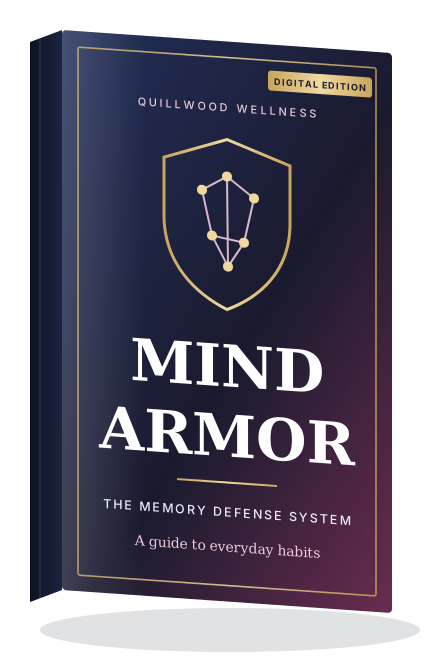
- Available with or without video lessons
- Help preparing questions for your healthcare provider
- A supplement, medication or medical device
- Medical advice or a substitute for your doctor
- A treatment for any disease or condition
- A promise of any particular result
Formats and prices
Both are digital and paid once in U.S. dollars. No subscription.
| Guide Access | Guide + Video Lessons | |
|---|---|---|
| Price (one-time) | $147 | $250 |
| Complete digital guide, all 4 parts | ✓ | ✓ |
| Read on computer, tablet or phone | ✓ | ✓ |
| Video lessons for each part | — | ✓ |
| Choose | Choose |
Questions
How will I receive it?
Access instructions go to the email you type at checkout. There is nothing to ship.
Will I be charged again later?
No. Each format is a single payment with no subscription.
Can I ask for a refund?
Yes. Write to [email protected] from the email used at checkout, as described in the Terms of Use.
Mind Armor: The Memory Defense System is for informational and educational purposes only. It is not intended to diagnose, treat, cure, or prevent any disease. Individual experiences vary.
Sources
Statements on this page are backed by these peer-reviewed studies, which were independent and did not evaluate Mind Armor: The Memory Defense System.
- Raichle ME, Gusnard DA. Appraising the brain's energy budget. Proc Natl Acad Sci USA. 2002;99(16):10237-10239. pubmed.ncbi.nlm.nih.gov/12149485/
- Watson NF, et al. Recommended amount of sleep for a healthy adult: a joint consensus statement of the American Academy of Sleep Medicine and Sleep Research Society. Sleep. 2015;38(6):843-844. pubmed.ncbi.nlm.nih.gov/26039963/
- Park DC, et al. The impact of sustained engagement on cognitive function in older adults: the Synapse Project. Psychol Sci. 2014;25(1):103-112. pubmed.ncbi.nlm.nih.gov/24214244/
- Gómez-Pinilla F. Brain foods: the effects of nutrients on brain function. Nat Rev Neurosci. 2008;9(7):568-578. pubmed.ncbi.nlm.nih.gov/18568016/
- Kennedy DO. B vitamins and the brain: mechanisms, dose and efficacy — a review. Nutrients. 2016;8(2):68. pubmed.ncbi.nlm.nih.gov/26828517/
- Morris MC, et al. Nutrients and bioactives in green leafy vegetables and cognitive decline: prospective study. Neurology. 2018;90(3):e214-e222. pubmed.ncbi.nlm.nih.gov/29263222/
- Erickson KI, et al. Exercise training increases size of hippocampus and improves memory. Proc Natl Acad Sci USA. 2011;108(7):3017-3022. pubmed.ncbi.nlm.nih.gov/21282661/
- Rasch B, Born J. About sleep's role in memory. Physiol Rev. 2013;93(2):681-766. pubmed.ncbi.nlm.nih.gov/23589831/
- Kelly ME, et al. The impact of social activities, social networks, social support and social relationships on the cognitive functioning of healthy older adults: a systematic review. Syst Rev. 2017;6(1):259. pubmed.ncbi.nlm.nih.gov/29258596/
- Goyal M, et al. Meditation programs for psychological stress and well-being: a systematic review and meta-analysis. JAMA Intern Med. 2014;174(3):357-368. pubmed.ncbi.nlm.nih.gov/24395196/
- Cherbuin N, Sachdev P, Anstey KJ. Higher normal fasting plasma glucose is associated with hippocampal atrophy: the PATH Study. Neurology. 2012;79(10):1019-1026. pubmed.ncbi.nlm.nih.gov/22946113/
Advertising Disclosure: This page advertises a digital educational product sold by Silverstone Media Group LLC.
Medical Disclaimer: The content of this page and of Mind Armor: The Memory Defense System is general and educational and is not medical advice. Consult a qualified healthcare professional about any medical concern.
FDA Disclaimer: These statements have not been evaluated by the U.S. Food and Drug Administration. This product is not intended to diagnose, treat, cure, or prevent any disease.
Results Disclaimer: Experiences differ from person to person and no outcome is guaranteed.